

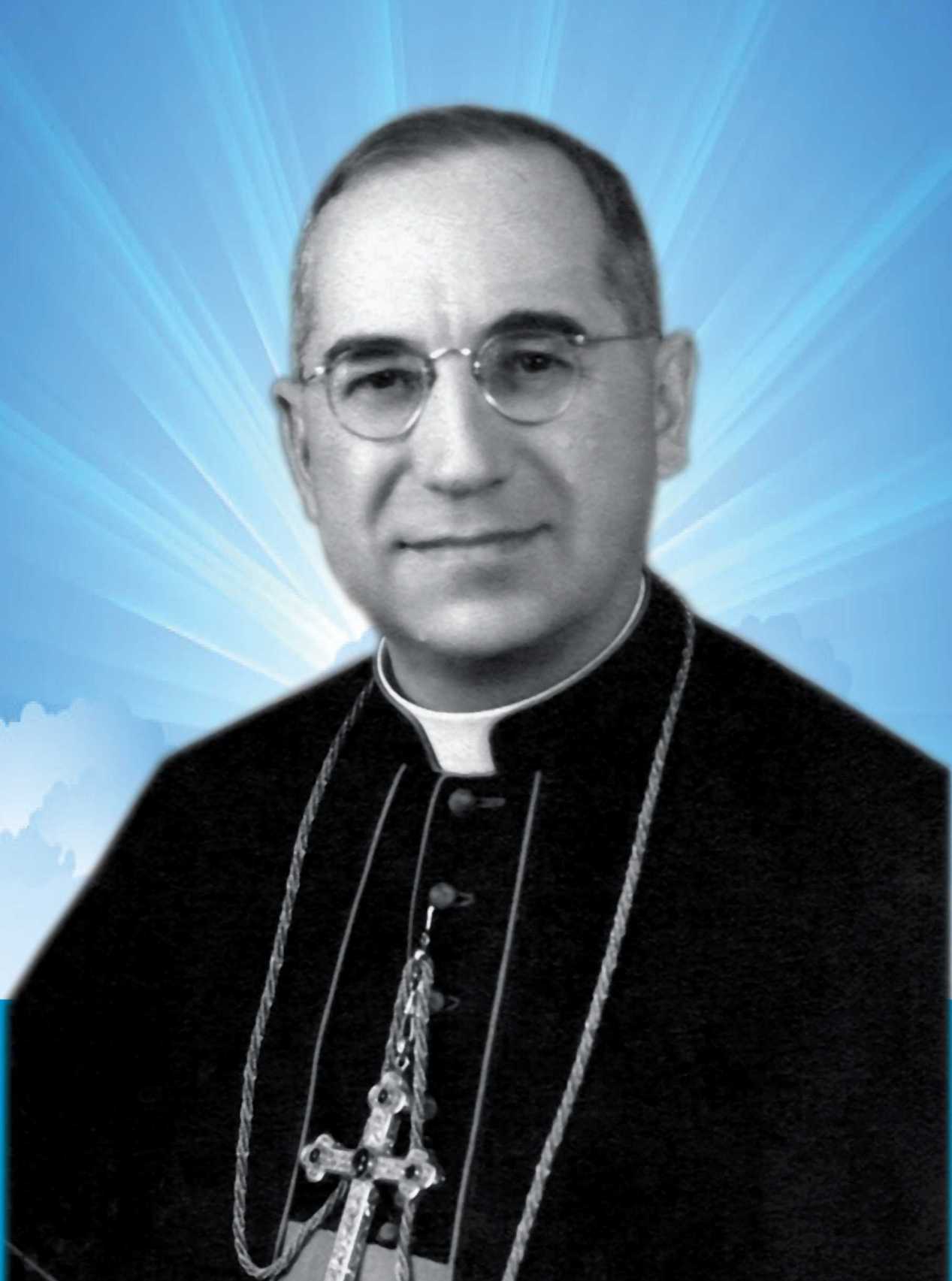
Of Krishnagar, 1939 - 1969
Most Reverend Louis LaRavoire Morrow, popularly known as "The Smiling Bishop" of Krishnanagar, was one of the rare individuals who dedicated his life selflessly to the betterment of humanity. He served as the Bishop of Krishnanagar from 1939 to 1969. His herculean efforts, patience, foresight, selfless love, wisdom, and commitment as a shepherd and writer are noteworthy and have earned him a renowned place in India and abroad.
Louis L.R. Morrow was born of an ecumenical marriage on 24th December 1892, at Weatherford, Texas, USA. His father, Joseph LaRavoire, was a French Catholic, and his mother, Isabel Morrow, was an American of Irish heritage and a staunch New Jersey Episcopalian. They had three children: Frank, Louis, and Margarita. In 1921, "Louis" was ordained as a priest in Puebla, Mexico, marking the beginning of his glorious career of service. On 29th October 1939, he was consecrated Bishop of Krishnanagar by Pope Pius XII at St. Peter's Basilica in Rome. His coat of arms bore the inscription, "To Jesus through Mary," reflecting his lifelong devotion to the Blessed Mother.
Upon his arrival in Krishnanagar on 25th October 1940, the literacy rate was 4.5%; by the time of his retirement in 1969, it had risen almost to 100%. He set his heart on the formation of a solid, well-mannered, and educated Christian community. To realise this vision, his primary endeavour was to ensure that all children attended school. Consequently, he purchased land for expansion, constructed buildings, and equipped mechanical workshops, a carpentry unit, and an industrial centre. Being a priest, educator, and lover of children, he was interested in the development of the "whole person." The mission’s existing schools—the Don Bosco School for boys and the Holy Family School for girls—along with the technical school, were well-equipped with modern machinery and flourished under his guidance. The high school boys' musical band was also fully equipped with a complete set of instruments.
The first of many challenges he faced was the Second World War. The British authorities in India decreed that all Italians were to be interned at Dehra Dun. Bishop Morrow immediately swung into action. He informed the local British authorities that they could cut off his right arm if they found one of his Italian priests doing anything detrimental to the war effort. He sent urgent telegrams to the Governor of Bengal in Kolkata and the Viceroy in New Delhi. In desperation, he even sent a cable to Her Majesty the Queen of England at Buckingham Palace. On the day the priests were scheduled to depart for the internment camp, the Bishop received a forty-eight-hour reprieve. Subsequently, a letter arrived from Sir Conrad Smith, the Home Minister of the Government of India, stating that due to his "splendid work," the British had decided to allow the Bishop to keep his Italian staff in Krishnagar. It was the only such exception granted to any Catholic mission in India.
The next crisis was the Great Famine of Bengal in 1943. During this catastrophe, the Bishop and his staff shared everything they had with the people. He was appointed Chairman of a voluntary Citizens' Food Committee. He solicited aid day and night from benefactors and personally visited Kolkata to secure surplus food from Indian, British, Australian, and U.S. officers. While coping with the stream of refugees pouring into Krishnagar, the Bishop contacted the Catholic Relief Services (CRS) in New York for more food supplies, which were distributed regardless of caste or creed. As the CRS had no representative in India at the time, Bishop Morrow served in that capacity for North East India from 1944 until a permanent office was opened in Kolkata in 1959. The Bishop and his staff worked tirelessly, keeping vigil with the people in their homes throughout that nightmarish year.
In 1947, the Bishop faced the crisis of the Partition of India, which resulted in the sudden amputation of two-thirds of his diocese and more than half of its population. His timely intervention helped ensure that Krishnagar remained within the Indian Union. As a flood of refugees poured across the border from the newly formed Pakistan (now Bangladesh), he provided shelter based solely on need, without regard to caste or creed. His all-embracing love and reconciling presence significantly diminished the violence that marked other border areas.
When Mahatma Gandhi was assassinated in 1948, fifteen thousand mourners assembled on the banks of the river Jalangi for a memorial service. Father Bishop was one of the three leaders invited to speak, alongside a Hindu and a Muslim. He urged the people to follow the example of the Father of the Nation and to work consistently for the welfare of India.
In 1945, Bishop Morrow introduced the practice of Family Communion on New Year’s Day. On 12th December 1948, he laid the foundation of the Congregation of the Sisters of Mary Immaculate, making a significant contribution to the welfare of children and the nation. The magnificent Cathedral of Krishnanagar, with its silvery dome and clock tower, was built between 1950 and 1952 and stands as his architectural masterpiece. Another point of interest is the huge recreation hall by the side of the cathedral, which was originally an aeroplane hangar gifted by friends from Cincinnati, Ohio, in 1957. In this hall, the Bishop provided instruction through audio-visual aids to promote the growth of both children and adults. Other projects initiated by him included a new water system, vocational training centres, road construction, dispensaries, and maternity hospitals.
After India gained independence, prominent citizens requested that the Bishop stand for election as a Commissioner of the Municipality. He was elected in 1952 and subsequently re-elected in 1955, 1959, and 1962. In 1965, due to the demands of his work at the Second Vatican Council, he asked his fellow commissioners to excuse him from standing for further re-election. During his tenure, he financed a long-needed extension of the city’s waterworks scheme and contributed generously to the new Municipal building. Furthermore, the first telephone system was installed through his efforts. The local administration offered him the first telephone number as a gesture of gratitude; however, the Bishop insisted that the District Magistrate receive the first number, followed by the Superintendent of Police and the Maharani of Nadia. He accepted number four for himself. In 1950, he was also appointed an Official Visitor to the Krishnanagar jail, a non-political role given to the most respected citizens of the community. Among other contributions, he secured an X-ray machine for the city’s TB clinic from the U.S., served as a consultant for the Indian Red Cross Society (West Bengal) from 1960 to 1969, and successfully appealed to Pope Paul VI for funding for the Krishnagar stadium. He also provided significant support to the Children’s Park, the Rama Krishna Pathaghar (City Library), and Sri Aurobindo Bhavan (Students' Health Home).
He authored numerous books for children, which have been translated into many languages. His catechism, Our Catholic Faith, is the most renowned of his publications and enjoys international repute. Upon his retirement in 1969, he continued his apostolate of the written word, updating his books and distributing copies of the Holy Bible in English and Bengali. An ardent advocate for women’s rights, he believed that justice and peace could not prevail unless women held an equal voice in legislative assemblies worldwide. He was also a faithful attendee of the Catholic Bishops' Conference of India (CBCI), serving as the convener of its Assessment Committee from 1969 to 1976.
On 23rd May 1984, the Bishop suffered a fall, resulting in a fracture of the left femur. For three and a quarter years, he bore this condition with a smile. On 28th August 1987, he suffered a serious bout of lung congestion. He rallied until the morning of the 31st. Surrounded by his confreres and sisters singing and praying, he passed away peacefully at 9:35 am. In compliance with his wishes, his mortal remains were laid to rest in the Cathedral crypt in the side chapel of Mary Help of Christians, which he had built.
Bishop Morrow was an exceptionally gifted person. Those who lived with him were deeply impressed by his genuine love, humility, and cheerfulness. He was a benevolent father, eager to make others happy, and he created a loving atmosphere conducive to all-inclusive growth. He was honest, large-hearted, compassionate, optimistic, and foresighted. A meticulous planner and a great administrator with a practical mind, he cared deeply for the poor and those held in low esteem, respecting them all as children of God. Nothing could deter him from reaching out to his "prio sontangon" (dear children); whether braving extreme heat or cold, poor roads, or crossing the river on a makeshift raft, he ensured he reached distant villages.
We believe his great and loving soul is now enjoying the bliss of heaven. Let us treasure the motto he left as a precious legacy: "To love God and help others to love God!" May Father Bishop's gracious smile and encouraging words ever linger in our hearts, inspiring us to sow seeds of joy, love, peace, and harmony among all people as children of our most loving and tender Father.